
A collaborative research team supported by the NSF Center for Complex Particle Systems (COMPASS) has had its paper, “ComMat: Complex Material Datasets and Benchmarks for Graph Machine Learning,” accepted to the AI for Accelerated Materials Design (AI4Mat) Workshop at NeurIPS 2026, taking place in Sydney, Australia, in December.
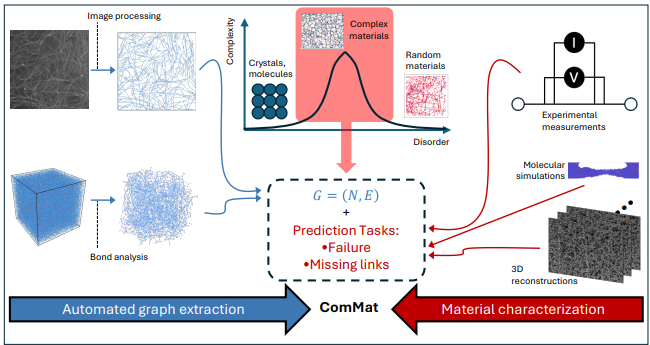
The research introduces ComMat (Complex Material Benchmark), an openly available collection of datasets designed to advance the use of graph machine learning in complex materials research.
Unlike conventional crystalline materials or highly disordered systems, complex materials combine elements of order and disorder. These intricate structures can offer valuable properties, but their complexity makes them particularly challenging to represent, analyze, and predict using existing computational approaches.
Building New Tools for Complex Materials Research
To address these challenges, the research team developed ComMat using three datasets drawn from experimental and computational studies:
- Polymer networks: Graphs derived from molecular simulations that support predictions of structural connections and material fracture.
- Silver nanowire networks: Graphs extracted from microscopy images that enable researchers to study and reconstruct network connectivity.
- Aramid nanofiber networks: A three-dimensional graph derived from tomographic imaging, containing more than 330,000 nodes. According to the researchers, this represents the first publicly available 3D graph dataset of a nanoscale network derived from tomography.
The researchers then evaluated established graph machine-learning models using these datasets. Their findings revealed significant challenges in predicting the structures and physical responses of complex materials, highlighting the need for new approaches that better capture their interconnected features.
By making ComMat openly available, the team aims to provide a foundation for future machine-learning research and accelerate the development of advanced materials.
Advancing Interdisciplinary Discovery
The study brings together researchers from the University of Southern California, University of Michigan, University of Pennsylvania, and University of Douala, combining expertise in materials science, computational modeling, and artificial intelligence.
The research was conducted by Trung-Kien Nguyen, Alain Kadar, Han Zhang, Wenbing Wu, Ahmet E. Emre, Yves Jonathan Ndje, Sharon Glotzer, Robert A. Riggleman, Nicholas Kotov, and Paul Bogdan.
The paper’s acceptance reflects COMPASS’s commitment to collaborative research that advances our understanding of complex particle systems and opens new possibilities for materials innovation.
Congratulations to the entire research team on this achievement!