K-12 Outreach Initiatives
Empowering Tomorrow’s Innovators
KidsWhoCode Program – KWC
One of the educational objectives of the COMPASS is to provide highschool students a pathway to gain the education and support needed to successfully pursue a career in STEM and knowledge-driven economy.
In 2017 UM graduate students in the Department of Computational Medicine and Bioinformatics, supervised and guided by UM faculty, launched the “Girls Who Code” (GWC) organization which provides a “fun and supportive environment for high school women to learn the power of coding.” The program was transferred to a virtual format because of the COVID-19 epidemic, engaging students in multiple schools in 30 cities, encompassing California, Maryland, North Dakota, North Carolina, and Alabama, among others. GWC has achieved exceptional educational outcomes with 75% of participants wanting to pursue STEM careers, 80% reporting an increase in self-confidence, and 62% still coding.
Kids Who Code (KWC) follows the GWC curriculum with an emphasis in applications of coding to analyze complex materials. KWC is taught by graduate students at different COMPASS universities. We utilize partner institution networks to advertise and recruit, where applicable, such as UM’s Office of Culture, as well as meet with K-12 schools Education leaders to promote our program.
The KWC curriculum is delivered in “bite-size” weekly lessons, followed by independent practice time to reinforce coding concepts and a capstone project with real-world data. The basic pedagogy is based on the “I do, we do, you do” didactic paradigm focusing on active student-centered learning. Completion of the curriculum ends with a capstone project that draws the students into integrating their learnings into creative coding for real-world problems and ongoing tasks in COMPASS.
Through COMPASS, KWC participants will be able to participate in a summer internship using the software package StructuralGT built from the research content developed by COMPASS. Graduate student instructors are assessed on their competence and growth in skill through an annual faculty–grad student program appraisal, with each student communicating successes and challenges experienced during that year, under the guidance of a group of three COMPASS faculty. We will spearhead the expansion of KWC by online dissemination of program information on the Center website, associated labs, institutions, and social media. This year, we had a cohort of 31 students, with plans to add additional class times in the future to extend our reach and improve accessibility.
High School Consulting Program
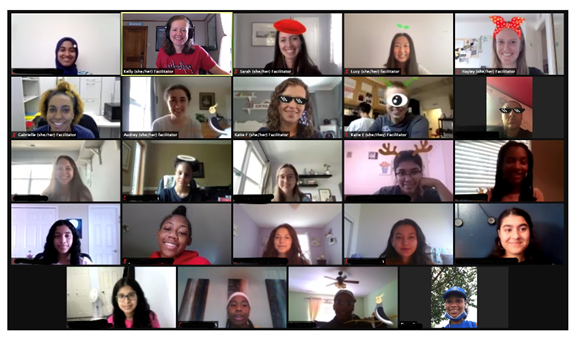
This online program is dedicated to expanding STEM opportunities for high school students. Through the support of the National Science Foundation’s Center for Complex Particle Systems (COMPASS), students can apply to receive one‑on‑one consulting from distinguished faculty across the country. Participants will have the chance to explore their scientific interests by meeting with faculty mentors or graduate students over Zoom for 30–60 minutes each week, gaining personalized guidance and exposure to a wide range of STEM fields.
Please fill out this form to request free consulting through our COMPASS Center!
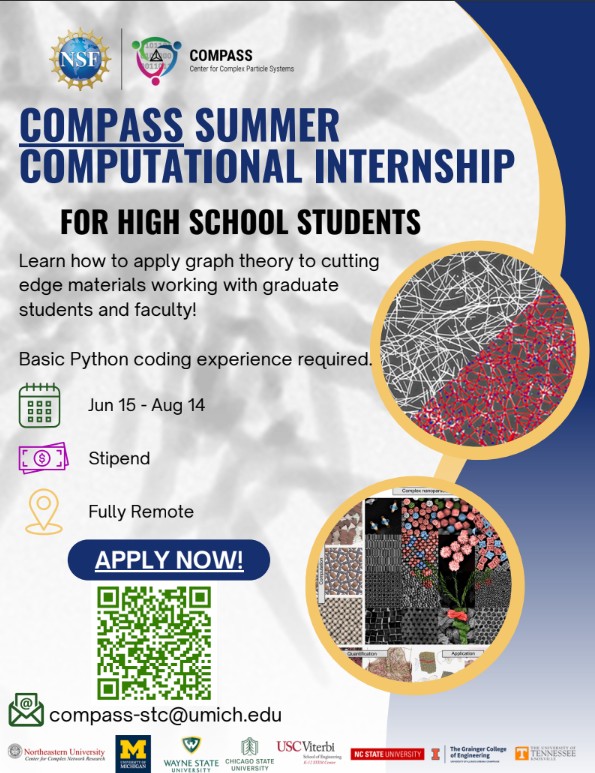
The Summer Computational Internship
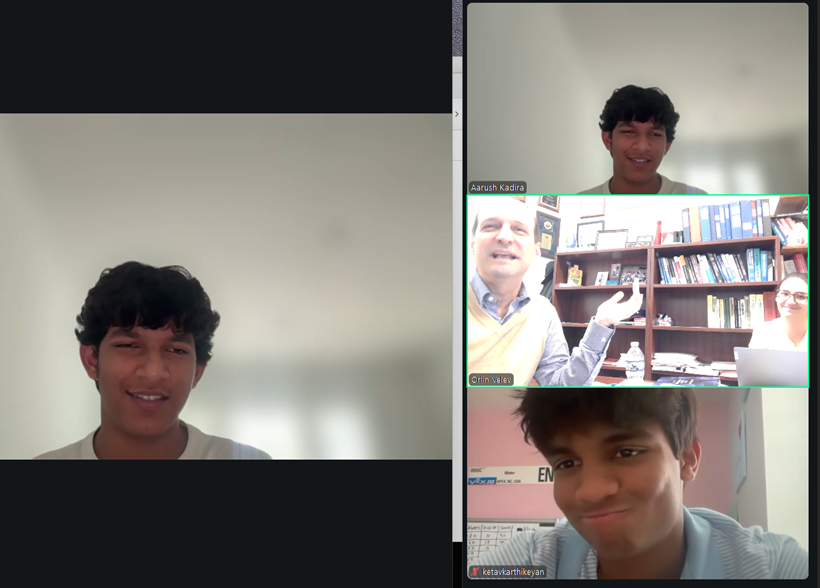
The COMPASS Summer Computational Internship is a fully remote, paid research opportunity.
Building on the foundations of our Kids Who Code (KWC) program, this internship pairs high school students with graduate student mentors to work on cutting-edge “Math-to-Manufacturing” research projects.
Participants will gain hands-on experience using the Center’s proprietary software, StructuralGT, to process complex microscopy images and learn how computational modeling and graph theory are applied to solve real-world challenges in materials science.