
VR developed by Albert Liu, Sayed Ahmad Almohri, Rebecca Lindsey, Ankit Mathanker, Bryan Goldsmith, Ahmet Emre, Nicholas Kotov and Theodore Hall.
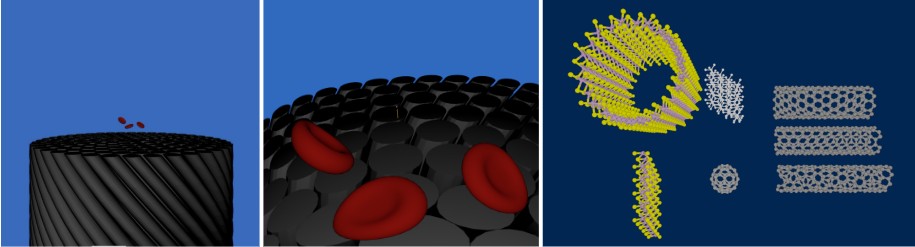
The objective of the first module is to help the students visualize and experience the different scales and structures of small-scale systems in relation to the macro-scale humans typically see in the daily lives. There are 2 activities in this module: (1) Particles across Scales and (2) Nanostructures. 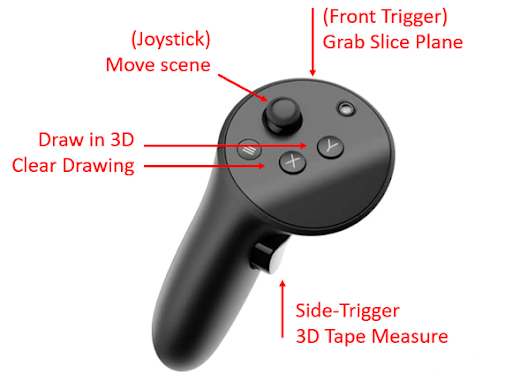
Once you get into the VR scene, the following are the controls. To move around the scene, you can walk around the room in real space. If the nanoparticle structure is not where you want it, you can use the joysticks on the controllers to move around the scene. Use the left-hand joystick to slide yourself forward-backward, left-right, or up-down. The position and orientation of the controller is tracked in 3D; point in the 3D direction you want to slide. Use the right-hand joystick to rotate yourself left-right. By using the two joysticks together, you can “orbit” by rotating right while sliding left, or vice versa.
Activity 1: Particles across Scales
This activity introduces students to the concept of scale in small-scale systems by allowing them to explore structures across a wide range of sizes. Students can transition from a human-scale reference, such as a strand of hair, down to atomic-scale structures like carbon nanotubes. Through interactive navigation and translation at different scales, this activity helps students develop an intuitive understanding of how small these structures are compared to everyday objects.
Activity 2: Nanostructures
This activity focuses on helping students understand the structural differences between various nanostructured materials, including carbon nanostructures, graphite, and molybdenum disulfide. Students interact with these structures in a 3D environment and use a VR measuring tool to determine structural distances, simulating real experimental measurements. This hands-on approach enhances their understanding of nanoscale arrangements and reinforces concepts related to material structure and characterization.
Additionally, we also have the CAVE version of Particles across Scales for students to compare the experiences between the different technologies.