
Nature often provides the best blueprint for innovation.
Proteins, the molecular machines that power life, owe their remarkable abilities to precisely organized patterns on their surfaces. These intricate surface features allow proteins to fold, recognize one another, and self-assemble into highly sophisticated structures that perform essential biological functions.
For years, scientists have sought to recreate this level of precision in synthetic materials. Researchers at the COMPASS Center for Complex Particle Systems have now taken a major step toward that goal.
Published in Nature Synthesis, the team’s latest research demonstrates a new approach for creating highly programmable nanoparticles by harnessing a feature that has largely been overlooked: the atomic-scale edges of gold nanoparticles.
Looking Beyond the Surface
At the nanoscale, even the smallest structural details can dramatically influence how materials behave.
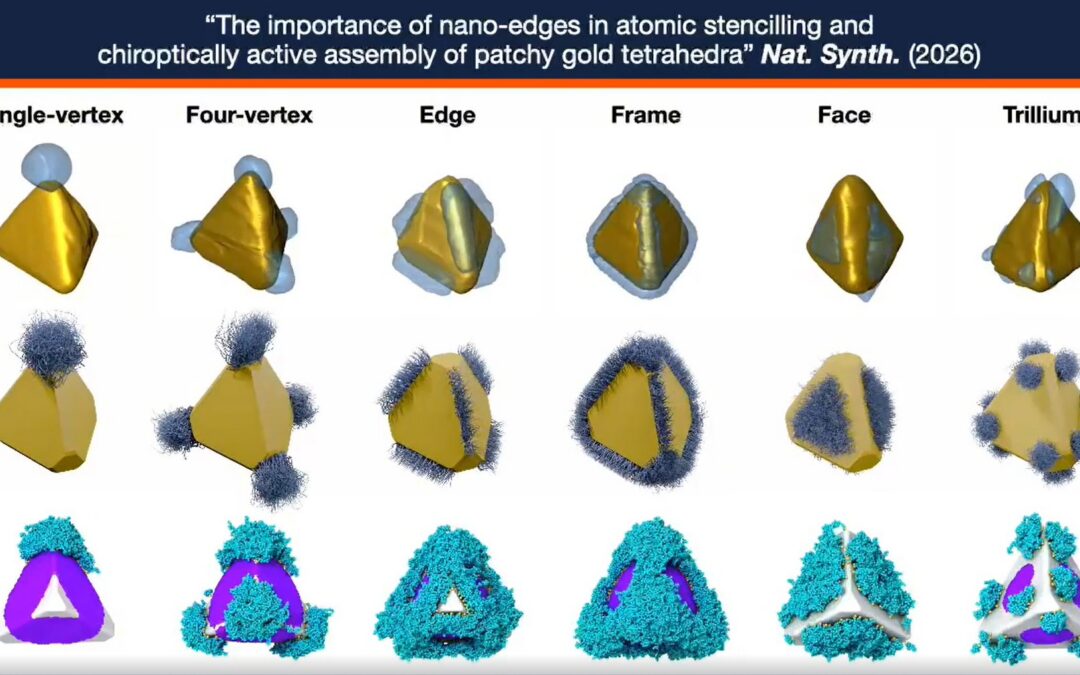
Using an advanced technique known as atomic stencilling, researchers engineered gold tetrahedral nanoparticles with precisely controlled polymer patterns across their surfaces. While previous work focused primarily on flat crystal faces, this study revealed that the tiny edges of the particles—previously considered insignificant—serve as critical sites for creating entirely new surface architectures.
By carefully adjusting iodide masking, polymer attachment, and solvent conditions, the team successfully created seven distinct surface patch patterns on a single nanoparticle shape. The ability to reproducibly generate this diversity of patterns dramatically expands the design possibilities for programmable nanomaterials.
Building Nanostructures Like Molecular Lego
Surface patterns determine how nanoparticles interact with one another.
The newly created “patchy” gold tetrahedra naturally self-assemble by connecting through their corners, edges, and faces in highly organized ways. Rather than forming random clusters, the particles assemble into predictable architectures that resemble the directional interactions seen in biological molecules.
One of the study’s most exciting discoveries is that these assembled structures exhibit chiroptical activity—they interact differently with left- and right-handed circularly polarized light—even though the individual nanoparticles themselves are not chiral.
This collective behavior emerges only after assembly, demonstrating how precisely engineered nanoscale building blocks can give rise to entirely new material properties.
A Powerful Combination of Experiment, Theory, and Simulation
The project combined experimental synthesis with polymer scaling theory and molecular dynamics simulations to understand—and predict—how different surface patterns form.
The remarkable agreement between experiment, simulation, and theory provides researchers with a predictive framework for designing new nanoparticle architectures instead of relying on trial and error.
This integrated approach represents one of COMPASS’s core strengths: bringing together researchers across disciplines to solve complex problems in materials science.
Expanding the Design Space for Nanotechnology
The findings suggest that nanoscale features once dismissed as imperfections—including edges, corners, and subtle geometric variations—can become powerful design tools for engineering advanced materials.
This expanded level of control opens exciting possibilities for developing programmable nanoparticles with applications across numerous fields, including:
- Catalysis
- Biomedical technologies
- Plasmonic sensing
- Energy harvesting
- Sustainable agriculture
- Advanced nanomanufacturing
Collaboration Across Institutions
This achievement reflects a highly collaborative effort involving researchers from the University of Illinois Urbana-Champaign, the University of Michigan, Argonne National Laboratory, and the COMPASS Center for Complex Particle Systems.
The study was led by co-first authors Dr. Xiaoying Lin and Dr. Chansong Kim, with senior leadership from Professor Qian Chen, Professor Nicholas A. Kotov, and Professor Sharon Glotzer, alongside an outstanding interdisciplinary research team.
As scientists continue to bridge the gap between biological precision and synthetic materials, discoveries like this move us closer to creating nanomaterials that can be programmed with the same sophistication found in nature itself.
Read the full paper: The importance of nano-edges in atomic stencilling and chiroptically active assembly of patchy gold tetrahedra, published in Nature Synthesis.